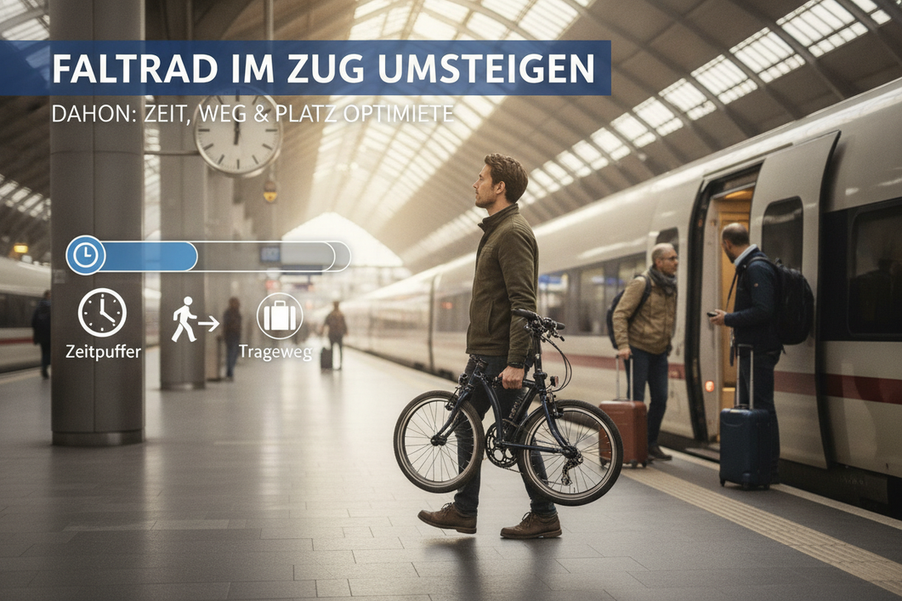
The train arrives in two minutes, the stairs are crowded – and the folding bike just won't fold up quickly enough. Anyone who has ever experienced the transfer between train and bike during rush hour knows: it all sounds simple on paper, but in the bustle of the station, every second counts.
A reliable folding bike-to-train transfer therefore cannot be determined by a blanket number of minutes. The decisive factors are your own, realistically measured folding time in combination with the longest path between platforms, your luggage, and local orientation. It is best to test this process in peace at your specific station – including your backpack or laptop bag. Always plan for a fixed reserve and an alternative connection to arrive at your destination in a relaxed and stress-free manner.

Planning a time buffer for train transfers with a folding bike
Your personal time buffer includes taking out and picking up the already folded bike, changing platforms, the effort required for luggage and orientation, as well as a personal reserve. The folding time only counts at the starting station or if the bike has not yet been folded before this section.
For certain bookings, DB offers the option of selecting a longer transfer time; however, a general minute value for every folding bike and every station cannot be derived from this.
Check the folding procedure of your folding bike and then test the entire connection under realistic conditions.
Assessing the pick-up of the folding bike and platform change separately
First, measure the folding time as a separate process: from coming to a safe stop to having a compactly folded, controllable folding bike. Then look at the platform change separately. Elevators, stairs, underpasses, construction sites, platform length, and the position of the boarding area can change the actual path more significantly than the mere distance on a map.
During the test run, also note whether you need to open doors, use a handrail, or lift the folding bike briefly. A theoretically short path is not a reliable connection if an elevator is occupied or an access point is not usable on site.

Adding a buffer for luggage and orientation
Calculate the process in separate modules:
- Time for picking up the folding bike and disembarking
- Disembarking and orientation on the platform
- Longest actual path section including platform change
- Boarding, positioning, and stowing
- Luggage handling and a personal reserve for minor delays
Perform this test with your usual backpack, laptop, or groceries. Do not just measure one particularly fast repetition, but a process you can carry out in a controlled manner during rush hour. If the connection only works at optimal speed, a later connection is usually the more plannable choice.
Keeping the path at the station short and manageable
The right station route is not automatically the shortest one, but the one you can manage in a controlled manner with a folded bike and luggage. Evaluate access, platform changes, lifting maneuvers, and carriage position together; for those traveling alone, having one hand as free as possible is also an important selection criterion.
Check before the trip:
- Is the intended entrance or elevator actually usable for this connection?
- How many changes of direction, stairs, or underpasses does the path contain?
- Do you have to lift the folding bike, and can you carry your luggage in a controlled manner while doing so?
- Does the route fit the position of the carriage you are likely to board?
- Does one hand remain free for the door, handrail, or the folding bike?
A path with slightly more distance can work better in everyday life if it requires fewer lifting maneuvers and no unnecessary detours through an inaccessible area. For recurring trips, check the current station information and document a second route. Planning multi-modal routes with a folding bike can serve as supplementary guidance, but does not replace testing at your own station.
Stowing the folded bike correctly on the train
Stow the folded bike only where it can be accommodated according to the conditions of the specific connection and does not obstruct doors, passageways, or safety equipment. On Deutsche Bahn, according to the current FAQ, a folded folding bike can generally be taken along free of charge as hand luggage; this statement does not automatically apply to every transport company, every association, or every type of train.
Checking available areas by train type
The specific storage space depends on the train layout, occupancy, and the applicable conditions. You should not understand possible areas as a guaranteed standard space, but rather evaluate them for available room, secure footing, and consideration before parking.
| Area on the train | When it can be suitable | Check before stowing |
|---|---|---|
| Designated bicycle or luggage area | If the area is intended for the specific connection and is free | Conditions, occupancy, and designated special areas |
| Other permitted luggage space | If the connection provides this area for luggage | Stability, accessibility, and unobstructed safety equipment |
At DB, a folded bike should be stowed like luggage. Luggage racks or multi-purpose areas may be considered; aisles, doors, and safety equipment must remain free. DB also points out different luggage areas on the train, so the storage location must be chosen according to train type and availability. A specific area is therefore not guaranteed for every trip.
Considering the storage space before boarding
- Check the intended boarding area before getting on if possible.
- Evaluate the conditions, occupancy, free space, and secure footing there.
- If occupied, switch to another permitted option without blocking access.
Position the folding bike compactly and accessibly without it protruding into the movement space of other passengers. Check doors, passageways, and safety equipment again after stowing. Stowing a folding bike on the train therefore depends on the applicable conditions and available space: check rules and clearance first, then position it, and re-evaluate if occupancy increases.
Organizing luggage and the folding process for transfers
A well-prepared folding process not only reduces handling steps but also keeps the folding bike and your luggage under control. Close or secure loose bags before folding, protect delicate items, and choose accessories based on actual folded dimensions, space requirements, and additional carrying effort.
Securing loose bags before folding
Prepare your backpack, laptop bag, and smaller items before you fold the bike or board the train:
- Close bags and secure loose straps or tags
- Remove bags if they could touch joints, wheels, or doors
- Keep laptops and accessories in a sturdy, easily accessible compartment
- Distribute heavy items so the folding bike can be carried in a controlled manner
- Arrange the process so that one hand remains free for the door, handrail, or folding bike
For bicycles, DB recommends removing luggage items before loading. For a folded bike, this is a sensible practical preparation, not a specific requirement for cases or luggage. The decisive factor is that nothing loose gets caught between moving parts or in the boarding area during folding.
Selecting protection and accessories based on everyday needs
A transport cover can be useful if clothing, clean interiors, or frequent contact with other luggage suggest an additional protective solution. However, it increases weight, packing effort, and handling steps. Therefore, before choosing, check the folded size, space on the train, possibility for quick access, and the path through the station.
Whether a cover is required depends on the transport company, association, train type, and connection. Do not derive a general rule for Germany from this. When comparing accessories for transport, your own commuting process with the intended transport equipment should show whether the additional effort justifies the practical benefit.
Establishing a contingency plan for tight connections
A reliable contingency plan consists of a later connection, a second station entrance, and a second permitted stowing option. If the process cannot be carried out in a controlled manner, a later connection is usually more plannable than hectic running, risky carrying, or blocking a door.
Preparing connections and routes with reserve options
Establish these three decisions before your trip:
- Connection: Note a later connection or an alternative route that is compatible with your ticket and current conditions.
- Station: Check a second access point between platforms in case the preferred elevator or path is out of order.
- Stowing: Determine a second option that is only used if justifiable according to conditions, occupancy, and available space.
| Situation | Prepared option | Limit of the decision |
|---|---|---|
| Connection becomes tight due to path or luggage | Use later connection | Do not run hectically or carry the folding bike uncontrollably |
| Preferred access not usable | Choose second station access | Only use a path that is actually open and manageable |
| Designated area is occupied | Check second permitted stowing option | Do not block any door, passage, or special area |
Conditions may vary for local transport and associations. Check the details of the specific transport company, train type, and connection before the trip; DB explicitly points out association-specific regulations.
Re-deciding calmly if space is occupied
Keep the folding bike compact and controlled while you check the next permitted option. If a safe and considerate boarding is not possible, choose the prepared later connection or speak to train personnel. The connection is not reliable if doors, passages, or other passengers have to be inconvenienced for it.
FAQs
The most important questions regarding folding bike-to-train transfers concern transport conditions, the test run with luggage, and the decision regarding a transport cover. The specific connection, available space, and your own process remain the decisive factors.
How can a transfer with a folding bike be tested before the first commute?
Test the route with your usual luggage and note the folding time, path section, carriage position, and a realistic stowing option. Additionally, check an alternative access point and a later connection.
What needs to be considered when transferring with a folding bike and laptop?
Secure the laptop, charger, and accessories in a sturdy bag before folding. If one hand is not free for the door, handrail, or folding bike, the luggage setup is not yet practical enough for this transfer.
Is a transport cover useful?
A cover can be useful for frequent contact with other luggage, but increases weight and handling steps. Compare folded size, accessibility, and space situation in your own routine.
What applies in the case of deviating transport conditions?
Check the details of the specific transport company, association, and train type. DB rules cannot automatically be applied to every connection.
Plan your folding bike-to-train transfer with a test run, reserve, and contingency connection. Check conditions before the trip and choose the later connection if you are uncertain.