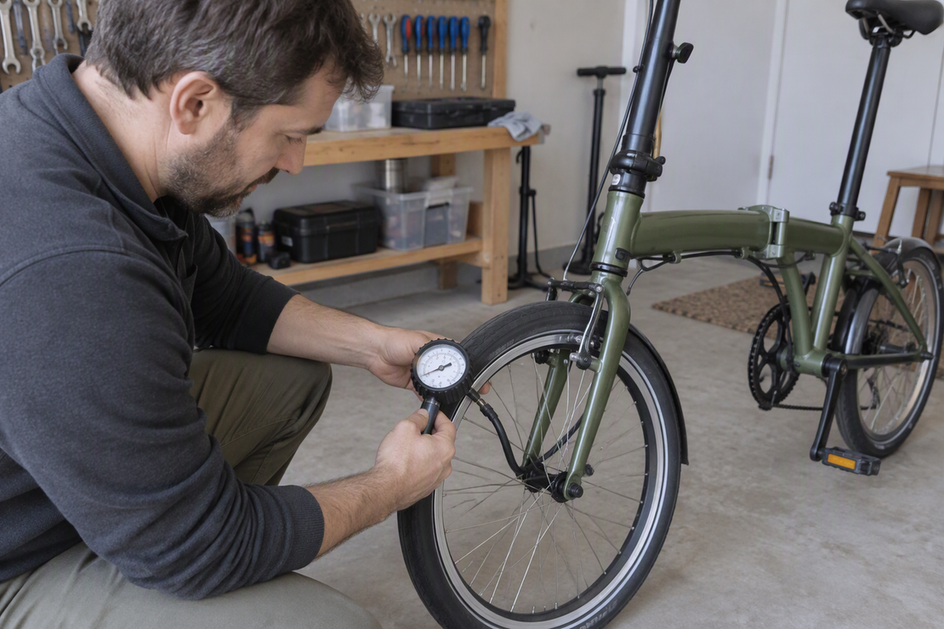
A folding-bike tire that goes soft overnight can be leaking at a point you cannot see: the valve, a small hole in the inner tube, the rim area, or the seal of a tubeless setup. The missing puncture and the overnight timing do not tell you which part is at fault. They also do not mean the tire itself needs replacing.

To solve a folding bike tire leak, first find out whether the wheel runs an inner tube or is tubeless. Then confirm the loss with a gauge before you take anything apart.
Why a folding-bike tire can lose air overnight
Air can escape from any part of the system that holds it, not only through the tread. Which parts matter depends on whether your wheel uses an inner tube.
On a tubed wheel, the tube holds the air. A tiny hole in the tube can leak slowly without leaving a mark you can see on the tire. The valve is another route: a leaky valve core is one possible source of air loss. The rim area also matters, because a damaged rim strip or a sharp edge inside the rim can damage the tube from the inside.
In most bicycle tubeless systems, air retention depends on a compatible tubeless tire and rim, an airtight rim bed or correctly installed rim tape, a sealed tubeless valve and the correct type and amount of sealant. Old, dried-out or insufficient sealant can also contribute to slow pressure loss. A gap at any of these points can let air out. Even when everything is assembled to specification, some tubeless setups can still lose air slowly. No normal overnight amount is defined, so a soft tubeless tire still deserves a check.
So the first job is to confirm your setup. Your bike's specification or manual should say whether the wheels use inner tubes. If it does not, your dealer or a mechanic can confirm it.
Check whether air is actually escaping
A tire that feels softer when you squeeze it is an impression, not a measurement. It also does not show where air escapes. A repeatable gauge reading tells you whether pressure is really falling.
- Inflate the tire within the range approved for your exact tire and wheel. Our German-language guide to folding-bike tire pressure explains how tire width and load affect the right setting.
- Record the reading. Note the time and the room or outdoor temperature.
- Check again with the same gauge after a known interval, such as several hours or overnight, at a similar temperature. This same-gauge comparison method keeps the two readings comparable.
- Compare the two numbers. A lower second reading may indicate pressure loss, but allow for gauge tolerance, temperature differences and the small amount of air that may escape during measurement. A consistent or substantial drop under comparable conditions is a reason to investigate further. There is no universal cutoff for acceptable loss, so treat a repeated drop as your cue to look for the leak. If the readings match, you have no measured loss to chase yet; repeat the comparison before removing the tire.
Find the leak in a tubed tire
With an inner tube, the tube itself shows where air escapes once it is out of the tire. The position of that point then tells you which part needs attention.
Locate escaping air from the tube
- Remove the tube from the tire, keeping track of which way it sat on the rim.
- Listen and feel for escaping air along the tube and around the valve.
- If you cannot hear the leak, submerge the tube in water and watch for bubbles. The stream of bubbles marks the exact point where air is escaping.
- Mark that spot and note whether it is on the rim-facing side, the tread-facing side or at the valve, because the position matters for the next step.
Use the leak location as a clue
- Bubbles at the valve: the valve or valve core is the first place to check, though this clue alone does not rule out other issues.
- A hole on the rim-facing side: a hole on the inner edge of the tube can point to a failed rim strip, a protruding spoke or another sharp object inside the rim. Inspect the rim strip and rim bed before fitting a patched or new tube.
- A hole on the tread-facing side: this gives you a matching spot to inspect on the tire. Look and feel carefully along the inside of the casing at that point for anything still lodged there.
Each of these is a clue to where attention should go, not final proof of the cause. A tube finding on its own is not a reason to replace the tire.
Check a tubeless tire
A tubeless tire has no tube to dip in water, so the checks focus on the parts that form the seal. They help you find where air escapes, but they do not always show why.
Consider the valve and rim-strip area
- Valve: Park Tool's tubeless installation guidance says to check that the valve is secure in the rim.
- Rim strip or tape: the same guidance describes an inadequately sealed rim strip as a possible source of leakage, so look for tape that has lifted, wrinkled or shifted around the valve hole.
- Location test: apply leak-detection fluid to one area at a time, such as the tread, sidewall, bead, valve or rim, and watch for growing bubbles at the coated area. Bubbles that keep growing mark where air escapes and where to inspect next.

Keep bead and casing diagnosis bounded
A bubble at the bead tells you that air is escaping between tire and rim. It does not tell you whether the tire is poorly seated, the rim tape has failed underneath, or the tire and rim do not suit each other. Park Tool's tubeless compatibility guidance warns that building a tubeless setup from incompatible parts is neither safe nor reliable. Confirm that both your tire and rim are approved for tubeless use before you try to seal a persistent bead leak. When the location is clear but the cause is not, the tire and rim makers' instructions or a qualified mechanic should guide the repair.
Use the finding to choose a next step
Fix the part your finding points to, and replace the tire only when the tire itself shows a reason. Overnight air loss alone is not that reason.
- Valve leak: address the valve or valve core. The tire can stay.
- Rim-facing tube hole: correct the rim strip, spoke end or sharp edge first, so the same spot does not damage the next tube.
- Tubeless bead, tape or valve leak: reseat, reseal or secure the part as the tire and rim instructions describe.
- Worn tire: Park Tool advises replacing tires that have become thin or whose sidewalls have become brittle with age and started to crack. These are clear signs, though not a complete list.
- Torn casing: a rip in the casing is a structural problem. An unplugged rip can let the tube bulge through and burst, and no patch matches the strength of the original casing, so treat a boot as a temporary fix only.
- Measured loss but no location found: take your gauge readings and setup details to a workshop. Our German-language article on roadside repair limits explains which fixes you can handle yourself and when a workshop is the better option.
Before the next ride, inflate to the pressure specified for your exact tire and wheel, and confirm the tire sits evenly on the rim as its instructions describe. Repeat the same-gauge comparison under similar temperature conditions and confirm that there is no continuing unexplained pressure loss beyond the level expected for that system and measurement method. If your model's manual leaves the pressure or seating unclear, ask a qualified mechanic to confirm it. After a longer storage period, our step-by-step restart check also covers brakes, folding joints and drivetrain.
FAQs
How can I tell whether my folding bike has inner tubes or tubeless tires?
Your bike’s specification or manual can identify the original setup. If the tire, rim or wheel may have been replaced, inspect the current components or ask a qualified mechanic to confirm whether an inner tube is fitted. A tubeless wheel holds air without a tube, so its valve is fitted directly into the rim and seals at its base. If you are unsure, confirm the setup before choosing any of the checks above, because the tube and tubeless methods are different.
Why should both pressure readings be taken at a similar temperature?
Readings taken in very different conditions, such as a warm room in the evening and a cold balcony in the morning, are not a like-for-like comparison. Keeping the temperature similar and using the same gauge means a change in the reading is more likely to reflect air actually escaping rather than different conditions.
What should I tell a mechanic about a slow leak?
Say whether the wheel is tubed or tubeless and share your gauge readings with the times and temperatures. If you found bubbles, describe where: at the valve, on the rim-facing or tread-facing side of the tube, or at the bead, tread, sidewall or rim of a tubeless tire. This helps the mechanic go straight to the right component instead of starting over.
Can I fix the tube instead of buying a new tire?
A small, repairable puncture in sound tube material may be patched according to the patch manufacturer’s instructions. Replace the tube if the damage is large, close to or at the valve base, along a failed seam, or if the rubber is visibly degraded. Fix any rim-side cause first. A new tire becomes the topic only when the tire is thin, cracked with age or torn.