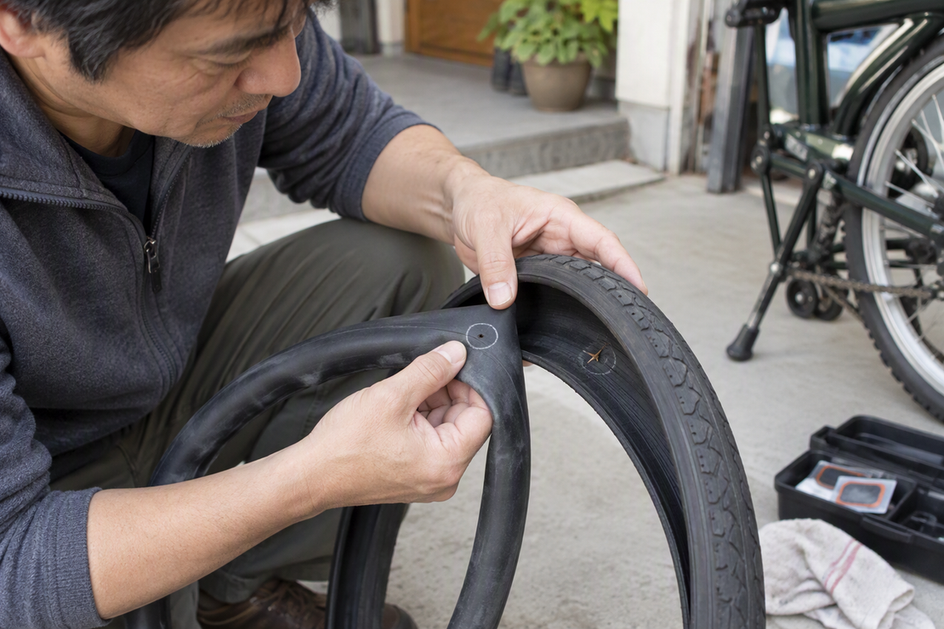
A flat tyre on your folding bike does not mean you need a new tyre. A small, single puncture in the inner tube may be repairable, as long as the tyre itself is sound and you have removed whatever caused the hole. If the tyre casing is damaged, replace the tyre.

If you can't tell whether the casing, sidewall or bead is sound, stop riding and have a mechanic look at it before you use the bike again. Once the unsafe options are ruled out, compare local itemised quotes for the options that remain.
Repair, assess or replace? Start with the damage
Where the damage sits decides the next step, not the fact that the tyre went flat. Bicycle repair guidance from Park Tool says a small tube puncture may be repairable, for example one caused by a thorn, wire or small nail. The same guidance shows a tyre with damaged casing as one that should be replaced. The casing is the fabric layer that gives the tyre its shape and strength.
| What you find | Next step |
|---|---|
| One small hole in the tube, tyre sound, cause removed | Tube repair may be suitable |
| Damaged tyre casing | Replace the tyre |
| Unsure about casing, sidewall or bead | Stop riding, get a mechanic's assessment |
| Tubeless tyre, safe repair unclear | Follow your system's instructions or get it assessed |
There is no fixed cut size that separates a minor mark from a tyre needing replacement. For tubeless setups (no inner tube, sealed with liquid sealant), repair advice for one sealant product does not cover every system; consult the instructions for your specific tyre and rim.
How to inspect the tube and tyre separately
Look at the tube and the tyre as two separate parts. A hole in the tube tells you the tube failed. It does not tell you the tyre is fine.
Locate the puncture and remove its cause
- Check whether your bike has inner tubes or runs tubeless before you follow any repair advice.
- Pump the tube up a little and find the leak. You can listen for hissing, feel for escaping air, or dip the tube in water and watch for bubbles.
- Mark the hole so you can match it to a spot on the tyre.
- Look for a thorn, wire, glass or anything else still stuck at that spot, and remove it before you patch or fit a tube. If the cause stays in the tyre, it can puncture the new tube too.
Check the tread, casing, sidewall and bead
Park Tool advises that you inspect the tread, casing, sidewall and bead every time you fix a flat.
- Tread: look for anything poking out. Squeeze any cut open to check for slivers of glass inside.
- Inner casing: look inside the tyre, wipe it with a rag, then feel carefully with your fingers for debris or cuts.
- Sidewall: look for rips, holes or damaged rubber and fabric.
- Bead: this is the wire or fabric edge that holds the tyre on the rim. Look for any damage along it.

A visual inspection reveals visible surface debris and obvious fabric tears, but internal cord separation requires a professional evaluation.
Compare safe options using local totals and the actual bike
Compare prices only for options that are both safe and a correct fit. A cheap patch is no saving if the casing is damaged. A tyre quote only counts if that tyre fits your bike. Workshop prices vary by country and by shop, so ask for itemised totals from workshops near you. Don't compare a part price with a fitted price.
| Option, if suitable | What the local total should include |
|---|---|
| Patching the existing tube | Patch and labour |
| Replacement tube | Tube and labour |
| Replacement tyre | Tyre, fitting, any new tube or other parts |
Before you count a replacement tyre as an option, check the tyre size, rim width and clearance on your actual bike. Cycling UK explains that a tyre whose diameter matches the rim will go on, but that doesn't mean it should. The tyre width has to suit the rim's inner width, and the frame, fork and mudguards limit how much space there is. Start by reading the ISO/ETRTO size on your current tyre's sidewall, such as 32-622 (width in mm, then rim diameter in mm). Some folding-bike parts are standard and others depend on the model. Our guide to model-specific replacement parts explains when a dealer or workshop is the better route.
Waste matters too. If a tube repair is suitable and the tyre is sound, you keep that tyre in use instead of throwing it away. That is never a reason to repair a structurally damaged tyre. For a wider view of running costs, see our overview of workshop and upkeep costs. To find a local workshop for an assessment, use our dealer store locator.
FAQs
Is a pre-glued patch a lasting fix?
Park Tool treats pre-glued patches as a temporary roadside fix and recommends replacing the tube soon afterwards. Glue-on vulcanising patches bond to the tube chemically and last longer when fitted properly.
Can a tyre boot save a ripped tyre?
A tyre boot is an emergency patch placed inside the tyre over a cut to prevent the tube from bulging. It does not restore structural strength and is never a substitute for replacing a damaged casing, which must be done before normal riding resumes.
What do two parallel slits in the tube mean?
Two matching slits usually point to a pinch flat. This happens when the tube gets squeezed between the rim and an obstacle. The tyre still needs the same inspection as for any other flat. For how pressure affects your ride, see our guide on folding bike tyre pressure.
Can I fit a wider tyre when I replace it?
Only if the rim width and the clearance in the frame, fork and mudguards allow it. Our article on wider balloon tyres explains what to check first.